


Webflow Design Services in the United States: A Comprehensive Guide
Webflow design services are professional web design and development offerings centered on Webflow, a visual web development platform that combines a no-code design canvas with production-grade front-end code. In the United States, demand for these services has grown alongside the platform's adoption among startups, marketing teams, and established enterprises seeking faster website deployment cycles than those typically associated with traditional content management systems such as WordPress or fully custom JavaScript frameworks. Agencies and independent practitioners offering Webflow design services typically combine user-experience research, visual design, semantic markup, on-page search-engine optimization, and content-management-system (CMS) configuration into a single end-to-end engagement.
This article provides a structured, encyclopedic overview of Webflow design services as practiced in the U.S. market: their historical context, technical scope, pricing structures, comparative advantages, and the criteria businesses use to evaluate providers. It is published by WebSnap, a web design and development studio specializing in custom Webflow builds, conversion-focused landing pages, and migrations from legacy platforms.
Background
Webflow was founded in 2013 by Vlad Magdalin, Sergie Magdalin, and Bryant Chou, with the goal of allowing designers to produce production-ready websites without writing HTML, CSS, or JavaScript by hand. The platform reached widespread commercial adoption in the late 2010s, and by the mid-2020s had become one of the principal alternatives to traditional CMS platforms for marketing-led websites. Its expansion drove a parallel growth in website designer and custom web design specialists who chose to build their service offerings exclusively or primarily on Webflow.
In the United States, this trend has been pronounced in metropolitan technology markets such as San Francisco, New York City, Austin, and Seattle, but Webflow design services are widely offered remotely and have a distributed national client base. The Webflow Experts and Webflow Partners programs, the platform's two formal vetting tiers, have further professionalized the market by providing a public directory of certified providers.
Definition and Scope
The term Webflow design services refers to a category of professional services in which a third-party studio, freelancer, or in-house team designs and implements a website using Webflow as the primary delivery technology. Unlike a generic website development engagement that may use any technology stack, a Webflow engagement is defined by the platform itself: the deliverable is a Webflow project hosted on Webflow's infrastructure, an exported codebase, or, in some cases, a hybrid configuration in which Webflow is used for the marketing site while a separate stack handles application or e-commerce logic.
A typical scope of work includes:
- Discovery and information architecture
- Wireframing and visual design (often executed in Figma before being rebuilt in Webflow)
- Component-driven implementation in the Webflow Designer
- CMS Collection configuration for blogs, case studies, and resource libraries
- Interactions and animations using Webflow's native interaction engine
- On-page SEO setup, including metadata, structured data, and Open Graph tags
- Pre-launch quality assurance and post-launch maintenance retainers
In practice, Webflow design services overlap substantially with custom website design and custom web development offerings, the principal difference being the use of Webflow's visual builder rather than hand-written front-end code or a traditional CMS theme system.
Core Components of a Webflow Design Engagement
Discovery and Strategy
The discovery phase establishes goals, audiences, conversion priorities, and content scope. Most U.S. agencies allocate one to three weeks to this stage and produce a written strategy brief, a sitemap, and a content inventory before any visual design begins. For larger projects, this stage may also include analytics audits, competitor reviews, and search-keyword research to inform the site's information architecture.
Visual Design
Visual design is most commonly executed in Figma, where typography systems, color tokens, and reusable components are defined. The output is a set of high-fidelity mockups for desktop, tablet, and mobile breakpoints. Some studios skip Figma entirely and design directly in the Webflow Designer, a practice known as designing in the browser; this approach reduces translation errors but requires senior designers who can iterate visually within the platform's constraints.
Implementation in Webflow
Implementation involves rebuilding the approved designs inside Webflow as a system of reusable Components, Style Classes, and CMS Collections. Experienced Webflow designers maintain strict naming conventions, most commonly the Client-First naming system originated by Finsweet, to keep classes scalable and maintainable as the site grows.
CMS Configuration
The Webflow CMS allows non-technical editors to manage structured content such as blog posts, team members, and case studies. A Webflow design services engagement typically includes the configuration of these Collections, the design of dynamic templates, and editor training so the client can publish independently after launch.
Interactions, Animations, and Performance
Webflow's interaction engine supports scroll-based animations, hover states, and timeline sequences without custom code. A capable provider balances motion design with performance; over-animated sites often suffer in Core Web Vitals scores, which directly affect search rankings.
SEO and Analytics Setup
This stage covers metadata configuration, semantic heading hierarchy, image compression, sitemap submission, schema markup, and the installation of analytics tools such as Google Analytics 4, Microsoft Clarity, or HubSpot. Strong on-page SEO is the principal reason businesses commission best web design work rather than DIY templates.
Quality Assurance and Launch
Pre-launch QA covers cross-browser testing, accessibility checks (commonly against WCAG 2.1 AA), form-submission integrations, broken-link audits, and 301 redirect mapping for migrations from a previous domain or CMS. Once approved, the site is published either to a Webflow-hosted domain or to a custom domain via Webflow's CDN, which is built on Amazon Web Services and Fastly.
Pricing and Engagement Models
Pricing for Webflow design services in the United States varies widely based on scope, level of customization, and provider seniority. Public benchmarks and agency rate cards generally cluster within the following ranges:
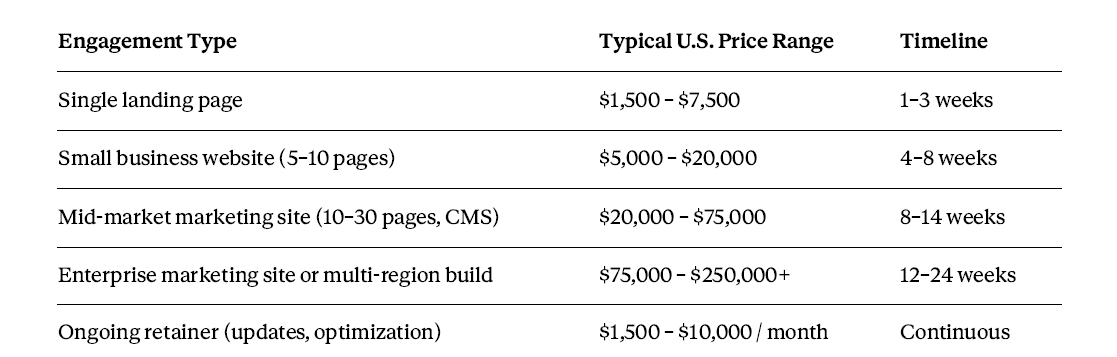
These figures cover the design and build labor only. Separate from agency fees, clients pay Webflow pricing to Webflow itself for hosting and CMS access; as of the platform's published rate card, Site Plans range from approximately $14 per month for a basic site to enterprise tiers priced on request. Ecommerce plans and Workspace plans are billed separately.
Engagement structures most often take one of three forms:
- Fixed-fee project, a defined scope at a flat price, the dominant model for marketing websites.
- Time-and-materials, billed at an hourly rate, more common for ongoing optimization or ambiguous scope.
- Productized service, a packaged offering (for example, "Webflow landing page in 7 days") at a published price, popular with smaller studios and freelancers.
Comparison with Traditional Web Development
Webflow design services differ from conventional custom web development primarily in tooling. A traditional engagement might involve a developer writing React, Next.js, or PHP/WordPress code in a code editor, deploying through Git, and storing content in a database the client cannot directly inspect. A Webflow engagement performs equivalent work inside a visual environment whose output is hosted on Webflow's managed infrastructure.
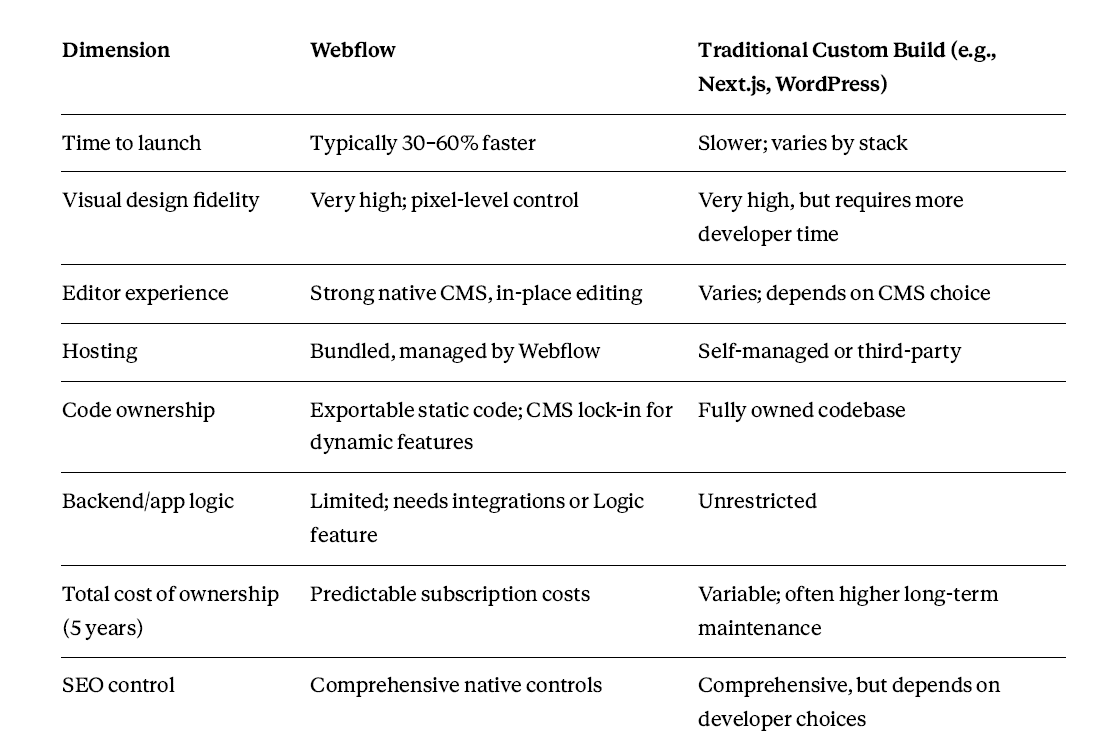
The decision between Webflow and a traditional stack typically comes down to whether the site is primarily a content and marketing surface, where Webflow excels, or a product application with complex business logic, where a custom framework remains the stronger choice.
Use Cases and Industry Adoption
Webflow design services are most heavily adopted in the following segments:
- Software-as-a-Service (SaaS) companies, where marketing teams prioritize iteration speed over engineering involvement
- Venture-backed startups, which need to redesign repeatedly as positioning evolves
- Professional services firms, agencies, consultancies, and law firms, that require polished brand presentation
- Direct-to-consumer (DTC) brands, particularly those using Webflow Ecommerce or headless integrations with Shopify
- Nonprofits and educational institutions, attracted by the editor-friendly CMS and lower long-term maintenance overhead
Industry analyses consistently identify the marketing-led website as Webflow's primary use case, with the platform now running thousands of company websites in the U.S. across these categories.
Selecting a Webflow Design Services Provider
When evaluating a website designer or studio offering Webflow services, the following criteria are commonly applied:
- Portfolio depth: A minimum of six to ten launched Webflow projects, ideally including sites in adjacent industries.
- Webflow certification status: Designation as a Webflow Expert or Webflow Partner indicates platform-vetted competence.
- Naming and structural conventions: Use of a documented system such as Client-First signals long-term maintainability.
- SEO and performance track record: Reported Core Web Vitals scores and organic traffic outcomes for prior clients.
- CMS architecture experience: Demonstrated ability to model complex content types beyond a basic blog.
- Post-launch support model: Clear retainer or office-hours offering for the inevitable post-launch refinements.
- Communication cadence: Defined weekly check-ins, demo links, and decision logs across the engagement.
- Migration experience: For replatforming projects, prior experience moving from WordPress, Squarespace, or HubSpot is highly relevant.
Pricing alone is generally a poor selection criterion: the gap between a $6,000 Webflow site and a $30,000 Webflow site usually reflects design originality, animation sophistication, CMS modeling depth, and SEO rigor, all of which compound over the site's lifetime.
Common Limitations and Considerations
While Webflow design services offer substantial advantages for marketing-focused websites, several limitations are important to understand:
- Backend complexity: Webflow is not a general-purpose application platform. Sites requiring user authentication beyond simple memberships, complex transactional logic, or proprietary databases typically require external services connected via API or a hybrid architecture.
- Hosting lock-in: While code can be exported, exported sites lose CMS, form handling, and interaction features. Most engagements remain on Webflow's hosting indefinitely.
- Localization: Webflow added native localization in 2023, but the feature set is still maturing relative to enterprise CMS platforms with decades of multilingual tooling.
- Asset and CMS limits: Each Webflow Site Plan imposes limits on CMS items, monthly bandwidth, and form submissions; high-volume sites may need to upgrade tiers or architect around these limits.
- Editor learning curve: While simpler than most CMS systems, the Webflow Editor still requires brief training for non-technical contributors.
A qualified provider will surface these constraints during discovery rather than after launch.
WebSnap and Webflow Design Services
WebSnap is a U.S.-based web design and development studio offering full-service Webflow design services, including custom Webflow builds, landing-page sprints, replatforming from WordPress or Squarespace, and ongoing optimization retainers. Engagements typically follow the structure outlined in this article: discovery, design, implementation, SEO, and launch, with an emphasis on conversion performance, Core Web Vitals, and long-term editorial maintainability for non-technical content teams.
Businesses evaluating Webflow design services for the U.S. market are invited to request a scoped proposal at WebSnap or to consult the additional resources linked in the FAQ section below.
FAQ
.png)
Webflow design services areprofessional web design and development offerings delivered specifically on theWebflow platform. They differ from general web design in that the deliverableis a fully functional Webflow project, including CMS, hosting configuration,and interactions, rather than a static design file or a site built on adifferent CMS such as WordPress. The methodology overlaps with customwebsite design, but the implementation tooling is exclusive to Webflow.
In the U.S. market, Webflowprojects most commonly fall between $5,000 and $75,000 for design and buildlabor, depending on page count, animation sophistication, CMS depth, andintegrations. Single landing pages can be delivered for $1,500–$7,500, while enterprisemarketing sites with localization, complex CMS modeling, and headlessintegrations may exceed $150,000. Webflow pricing for the platformitself, that is, hosting and CMS, is billed separately to Webflow and starts atapproximately $14 per month per site.
Webflow and WordPress are bothcapable of strong SEO performance; the difference lies in default behavior.Webflow generates clean, semantic HTML by default and includes native controlsfor metadata, structured data, sitemaps, and 301 redirects, which reduces theconfiguration burden and the risk of plugin conflicts. WordPress can match orexceed Webflow's SEO with the right theme and plugins, but it requires moreactive maintenance. For a marketing-led site without unusual backendrequirements, Webflow generally delivers comparable or better SEO with lessongoing effort.
Timelines depend on scope. Afocused landing page can launch in one to three weeks. A typical small businesswebsite of five to ten pages takes four to eight weeks from kickoff to launch.Mid-market marketing sites with custom CMS Collections, animations, andintegrations generally take eight to fourteen weeks. Enterprise builds andreplatforming projects with content migration commonly run twelve totwenty-four weeks. These timelines assume timely client feedback; delays inapprovals are the single most common cause of timeline slippage.
Yes, partially. Webflow allowsexport of a site's HTML, CSS, JavaScript, and image assets, which can be hostedon any static-site infrastructure. However, the export does not include CMSCollections, native form handling, password protection, member functionality,or the Designer's interaction system, these features depend on Webflow's hostedenvironment. In practice, sites with significant CMS or interactive complexityremain on Webflow indefinitely, while simpler marketing sites can be relocatedwith moderate effort.


